LLC vs S‑Corp vs C‑Corp: The 2026 Guide for Foreign Owners and Small Business Entrepreneurs in the U.S.
Why Your U.S. Business Structure Matters More Than You Think
In the U.S., choosing a business entity is not just a legal formality — it’s a tax strategy. The structure you pick directly determines:
- How much federal, state, and self‑employment tax you pay every year
- How you legally take money out of your own business
- Your personal liability if the business is sued
- Your ability to attract investors, add partners, or sell the company later
- The complexity and cost of your bookkeeping, payroll, and annual filings
Pick the wrong entity and you’re quietly losing money every quarter. Pick the right one and you unlock legal tax savings of $5,000 to $25,000+ per year for a typical profitable small business.
The Hidden Risk: Why Foreign Owners Get This Wrong
💡 Suggested photo here: stock photo of a worried small business owner looking at paperwork / receipts at a desk. See stock photo list at the bottom for exact search queries.
We’ve onboarded hundreds of clients who came to us after forming an entity. The most common story is the same:
- A relative or friend gave a casual recommendation (“just open an LLC”)
- A YouTube video made for U.S. citizens suggested an S‑Corp
- A low‑cost online formation service pushed a C‑Corp for the upsell
- The newly arrived entrepreneur signed without a tax consultation
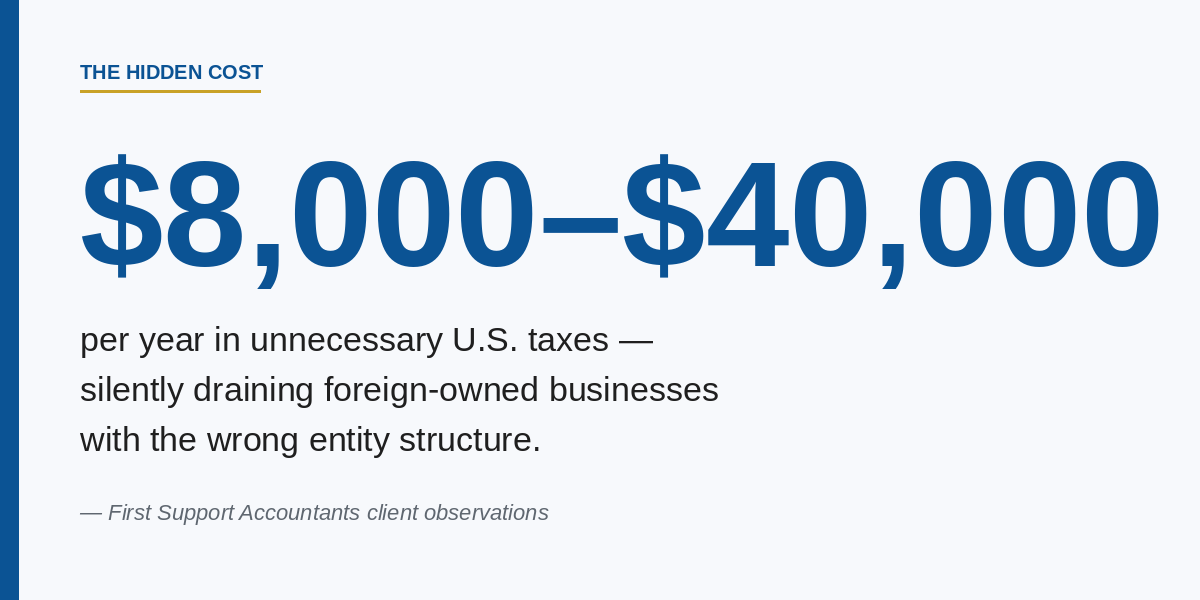
The result? Wrong structure, wrong state of formation, wrong tax elections, wrong payroll setup. We routinely fix structures that are silently costing owners $8,000 to $40,000 per year in unnecessary taxes.
Your situation is different from your cousin’s. A solo Uber driver earning $60,000, a real estate investor with three rental properties, and a restaurant owner with three employees should not share the same entity type — but they often do, because no one ran the numbers for them.
What Is an LLC (Limited Liability Company)?
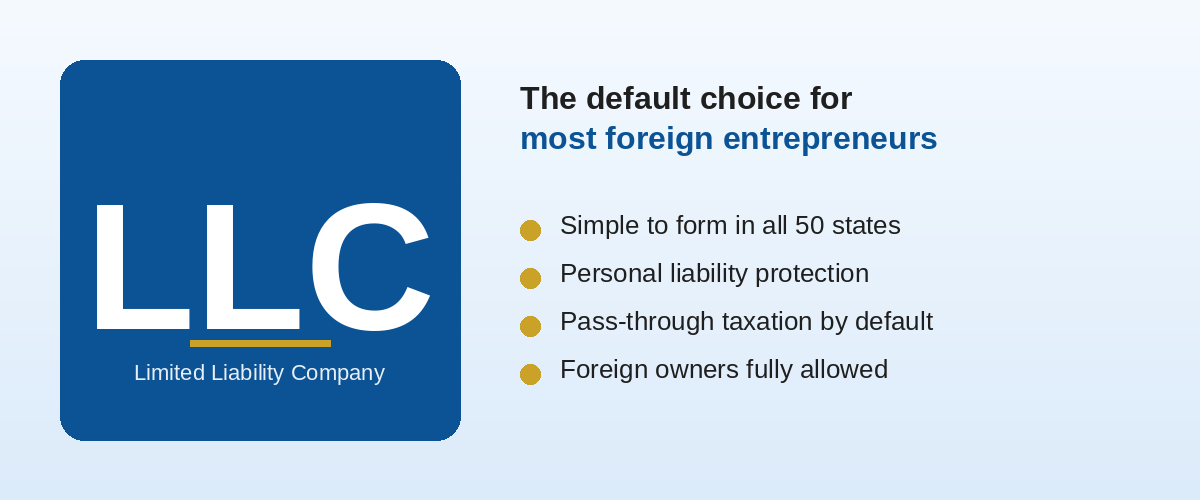
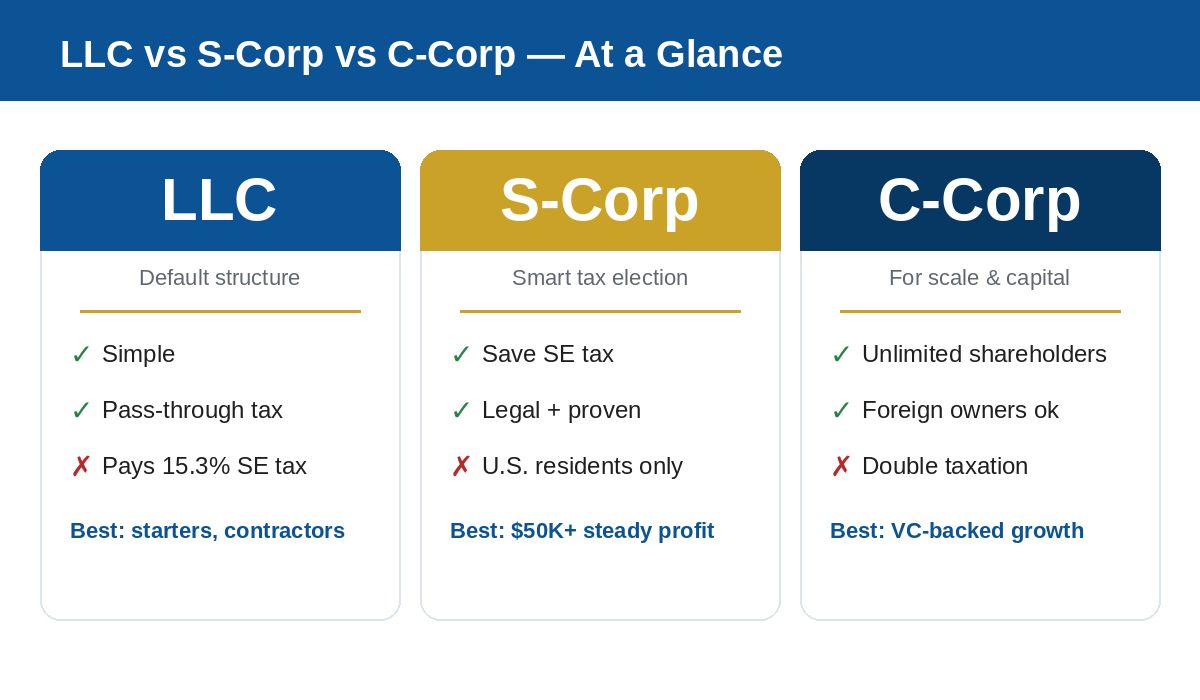
A Limited Liability Company (LLC) is the most popular business structure in the U.S. — and for most small business owners and foreign entrepreneurs, it’s the right starting point.
Key Advantages of an LLC
- Easy to form and maintain in all 50 states
- Personal liability protection — your house, car, and personal savings are legally separated from business risk
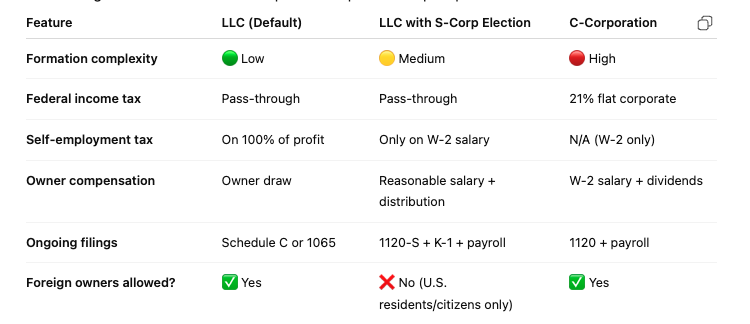
- Pass‑through taxation by default — the LLC itself does not pay federal income tax; profits flow to the owner’s personal return
- Flexible ownership — single‑member or multi‑member, with foreign owners fully allowed
- Low compliance burden — no mandatory annual meetings, no board of directors, minimal paperwork
When an LLC Is the Right Choice
- You are launching a new business and want to start simple
- You work as a self‑employed contractor (1099) or freelancer
- You own rental real estate and want to protect your personal assets
- You are a non‑U.S. resident forming your first American business
- Your annual net profit is under roughly $50,000
The Most Common LLC Mistake (We See It Weekly)
Entrepreneurs form an LLC, get the EIN, open a bank account — and then stop. They mix personal and business expenses on the same card. They skip monthly bookkeeping. They ignore quarterly estimated tax payments.
The result: a $15,000 to $40,000 tax bill in April plus IRS penalties and interest. The LLC was never the problem — the lack of a proper accounting process was. (This is exactly why our clients get bookkeeping bundled with the entity setup.)
What Is an S‑Corporation (S‑Corp)?
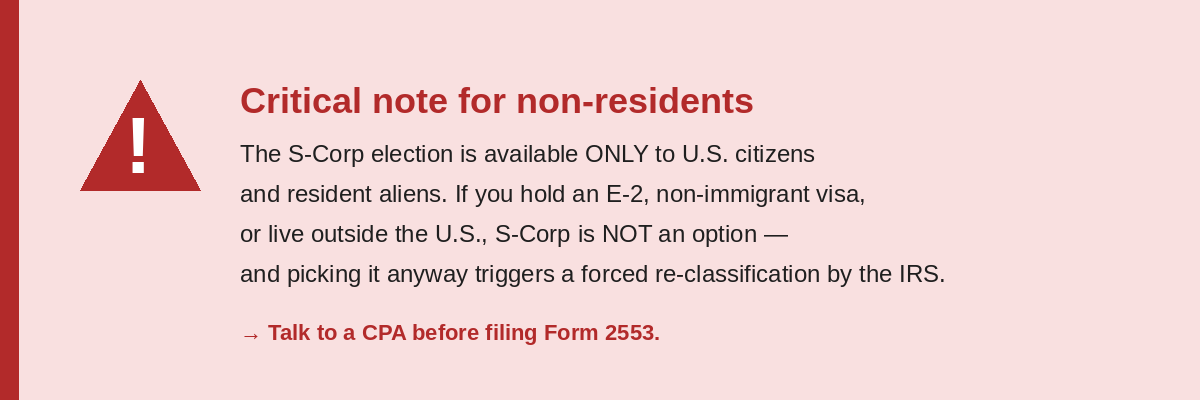
Here’s what most online guides get wrong: an S‑Corp is not an entity — it’s a tax election. Your LLC (or a corporation) files IRS Form 2553 to be taxed as an S‑Corporation. The entity itself stays the same; the tax treatment changes.
The Main Benefit: Legal Self‑Employment Tax Savings
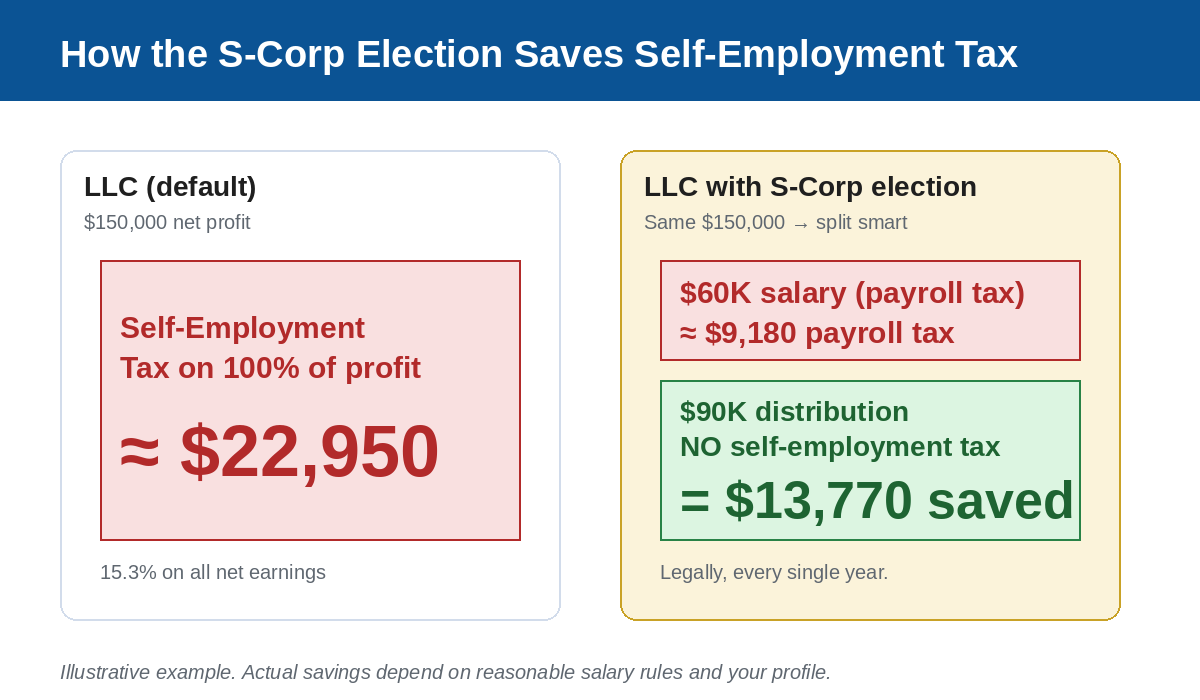
In a regular LLC, 100% of your net profit is subject to self‑employment tax — that’s 15.3% on top of federal and state income tax. With an S‑Corp election, your compensation splits into two streams:
- Reasonable W‑2 salary — subject to payroll tax (the equivalent of SE tax)
- Distribution of remaining profit — not subject to self‑employment tax
Done correctly, this single election can save $5,000 to $20,000 per year in self‑employment tax for a typical profitable small business. For a business netting $150,000, we’ve seen annual savings north of $12,500.
When the S‑Corp Election Makes Sense
- Your business nets $50,000 to $80,000+ per year consistently
- You can afford monthly payroll processing and accurate bookkeeping
- You plan to continue operating and growing the business long-term
- You want to formalize operations and build a track record
What the S‑Corp Requires (And Why It’s Not for Everyone)
- Monthly payroll — you become an employee of your own company
- Reasonable salary — the IRS expects your W‑2 salary to match market rate for your role
- Form 1120‑S annually plus K‑1 for each owner
- Strict bookkeeping and a clean separation between business and personal
Elect S‑Corp status too early — before the business is stable and organized — and the extra payroll + compliance costs can exceed the tax savings. At First Support Accountants, we model this decision with real numbers before recommending the switch.
What Is a C‑Corporation (C‑Corp)?
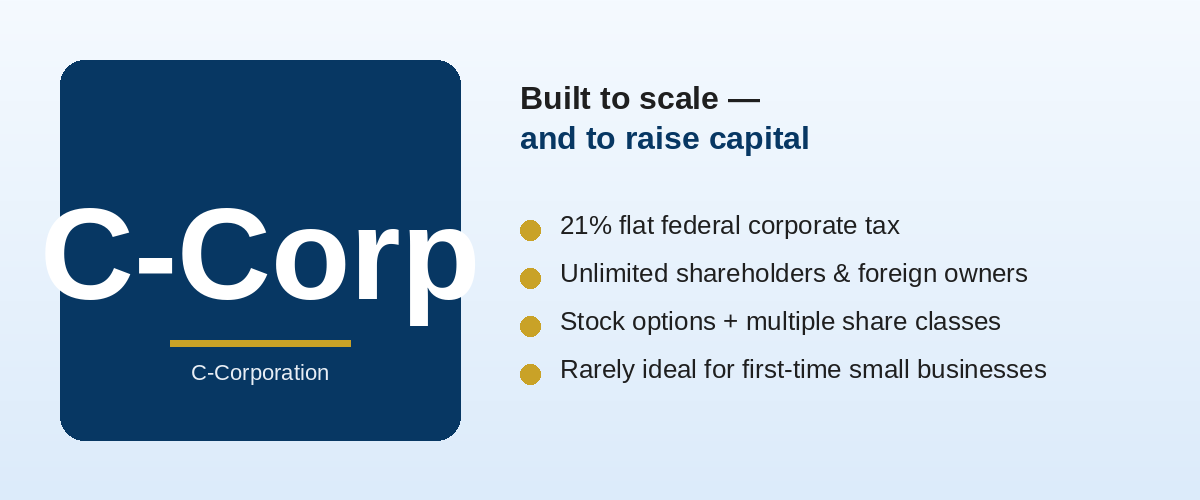
A C‑Corporation is the structure used by Apple, Google, Tesla, and virtually every venture-backed startup. It’s the most formal U.S. business entity — and for the average small business owner, it’s rarely the right choice early on.
Key Characteristics
- The corporation pays its own federal income tax (a flat 21% on corporate profits)
- Unlimited shareholders allowed, including foreign individuals and other corporations
- Multiple classes of stock — essential for raising venture capital or issuing stock options
- Formal governance — board of directors, bylaws, annual meetings, shareholder records
The Major Downside: Double Taxation
When a C‑Corp distributes profit as dividends, the money is taxed twice:
- The corporation pays 21% federal tax on the profit
- When the dividend reaches the shareholder, it’s taxed again as personal income (0%, 15%, or 20% depending on bracket)
For most profitable small businesses, double taxation erases any other benefit.
When a C‑Corp Is the Right Choice
- You plan to raise venture capital from angels, VCs, or private equity
- You’ll reinvest all profits into growth rather than distributing them
- You want to issue stock options to employees
- You’re building a company aimed at IPO or large acquisition
- Multiple foreign investors or foreign entities will hold shares
- You need the entity to be legally independent from the founders for regulatory or banking reasons
For a typical immigrant entrepreneur, real estate investor, or contractor, a C‑Corp usually creates more problems than it solves in the first five years.
How to Decide: 5 Questions We Ask Every New Client
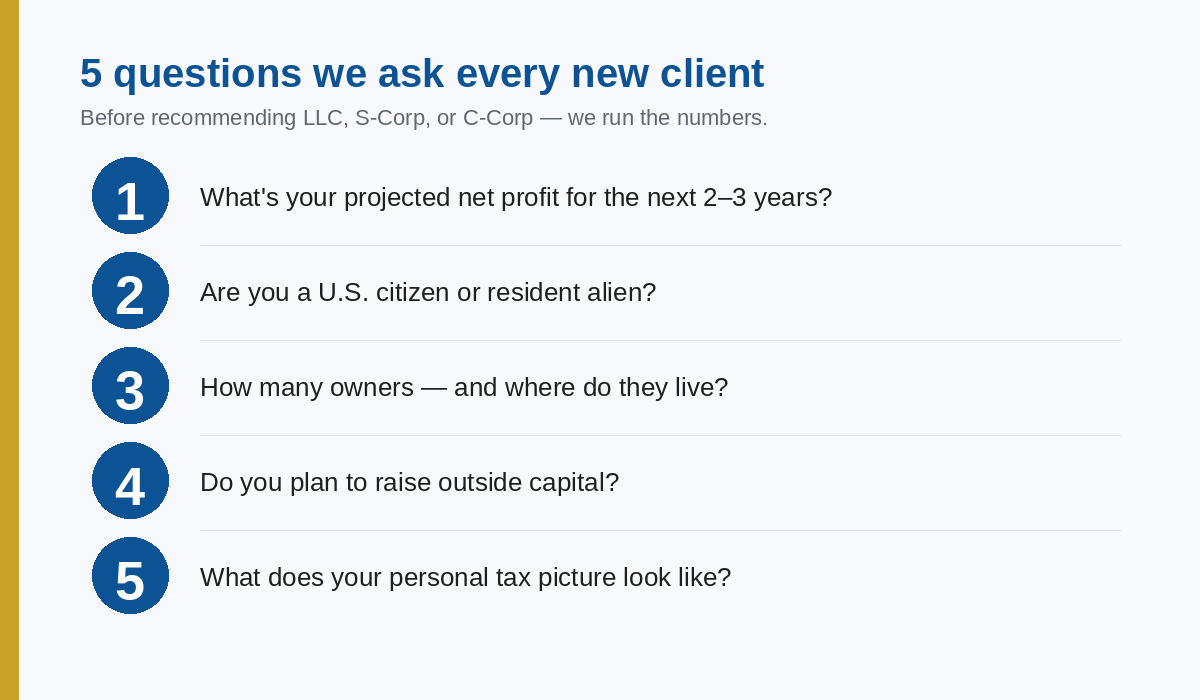
There’s no “best” entity — only the best entity for your specific situation. Here are the five questions that drive our recommendation:
- What is your projected net profit over the next 2–3 years? Under $50K → LLC. $50K–$400K → consider S‑Corp election. $400K+ with reinvestment → evaluate C‑Corp.
- Are you a U.S. citizen or resident alien? If no, S‑Corp is off the table.
- How many owners, and where do they live? Foreign co-owners change the answer significantly.
- Do you plan to raise outside capital? Only C‑Corps cleanly support venture funding.
- What is your personal tax situation? Residency status, ITIN vs SSN, foreign accounts (FBAR/FATCA), and dependents all affect the math.
Skip these questions and you’re guessing. Answer them properly and the right structure becomes obvious.
How First Support Accountants Helps Foreign Entrepreneurs Get This Right
💡 Suggested photo here: stock photo of a diverse professional team meeting or a warm handshake across a desk. Search queries at the bottom.
We are a bilingual (English and Portuguese) CPA firm built specifically for foreign-born entrepreneurs, investors, and small business owners in the United States. What makes us different:
- ✔️ Licensed U.S. CPAs and Enrolled Agents — not unlicensed preparers
- ✔️ Fluent in the foreign‑owner playbook — ITIN, FBAR, FATCA, U.S.–Brazil tax treaty, FIRPTA withholding, treaty‑based returns
- ✔️ Integrated services — entity formation, bookkeeping, tax planning, and payroll under one roof
- ✔️ Plain‑English (or Portuguese) explanations — no jargon, no surprises on the bill
- ✔️ Year‑round tax planning — not just once in April
We don’t just file your taxes. We build the financial structure that lets your U.S. business grow tax-efficiently for the next 10 years.
Take the Next Step: Free 30‑Minute Consultation

If you’re about to form a new entity — or you suspect your current structure is costing you more in taxes than it should — let’s talk. In your free 30‑minute consultation we will:
- Review your current situation, income, and business goals
- Run a side‑by‑side tax comparison of LLC vs S‑Corp vs C‑Corp with your real numbers
- Give you a concrete action plan with exact next steps and timeline
👉 Schedule Your Free Consultation at First Support Accountants
We serve clients across all 50 states — in English and Portuguese.
Frequently Asked Questions
Q: Can a non‑U.S. resident own an LLC? Yes. There is no citizenship or residency requirement to own a U.S. LLC. Many of our clients are foreign nationals who form LLCs without ever setting foot in the U.S. You will need an EIN and, in most cases, an ITIN.
Q: Can I convert my LLC to an S‑Corp later? Yes. You file IRS Form 2553 to elect S‑Corp taxation. The deadline is generally 75 days after formation or by March 15 of the tax year you want the election to take effect. Late elections are possible but require additional paperwork.
Q: What’s the difference between an EIN and an ITIN? An EIN (Employer Identification Number) is for your business. An ITIN (Individual Taxpayer Identification Number) is for a person who doesn’t qualify for an SSN but has U.S. tax obligations. Foreign business owners typically need both.
Q: Which state should I form my LLC in? For operating businesses, the correct answer is almost always the state where you actually operate. Delaware, Wyoming, and Nevada are over-marketed — and for a foreign-owned operating business, they can increase your costs through foreign qualification requirements in your home state.
Q: How much does it cost to form an LLC with First Support Accountants? Our entity formation service includes the filing, EIN application, operating agreement, S‑Corp election (when eligible), and a one‑hour tax planning session. Contact us for a current quote.
Q: Do you work with real estate investors? Yes — real estate is a significant part of our practice. We handle rental LLC structures, cost segregation, 1031 exchange planning, FIRPTA for foreign sellers, and depreciation strategy.
Final Word
Forming a business in the United States is one of the most powerful wealth-building opportunities available to foreign entrepreneurs. But the wrong structure quietly drains money from your business every single month — and by the time you notice, the cost to fix it is multiplied.
The right structure, set up correctly from day one, becomes an asset that pays you back for decades.
That’s what we do at First Support Accountants.
🔗 Start the conversation at firstsupportaccountants.com
This article is for informational purposes only and does not constitute legal, tax, or financial advice. Every business situation is unique — speak with a licensed professional before making entity decisions. Content reviewed by the First Support Accountants team. Last updated: April 2026.